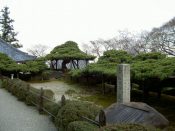
Yoshiminedera Temple
Yoshiminedera Temple is dedicated to the eleven-faced thousand-armed Avalokitesvara Bodhisattva.It declined after the Onin War, but was rebuilt in the Edo period thanks to a donation from Keishoin, mother of Tsunayoshi Tokugawa.It is also known for its cherry blossoms, hydrangea, and autumn leaves.....
Ryoanji Temple
Ryoanji Temple, a World Heritage Site, is said to have been built by Hosokawa Katsumoto in 1450 after he received a villa belonging to the Daitokuji family.The famous stone garden is composed of 15 stones divided into 7, 5, and 3, arranged so that all stones are not visible from any angle.....
Kajuji Temple
Kajuji Temple is dedicated to the Thousand-armed Avalokitesvara Bodhisattva.The pond garden, centering on the 6,000-square-meter Himuro-ike(Pond), is designated by the city of Kyoto as a place of scenic beauty.During the Heian period (794-1185), ice on "Himuro-ike" was presented to the court on Janu....
Jounangu Shrine
Jounangu Shrine is said to have originated in 816 when it became the guardian deity of the southern part of Heiankyo and became a government shrine.It is the "God of directional protection," "God of traffic safety," and "God of travel safety.Yutate Kagura" is held in January, "Shidare Ume and Camell....
Daigoji Temple
Daigoji Temple, a World Heritage Site, is the head temple of the Daigo school of the Shingon sect of Buddhism.In 907, it became an imperial temple for Emperor Daigo. The temple was destroyed by fire during the Onin War, but was rebuilt with donations from Toyotomi Hideyoshi.The 38-meter-high five-st....
Toji Temple
Toji Temple, a World Heritage Site, was built to the east of Rajomon Gate when the capital was moved to Heian-kyo by Emperor Kanmu.Its official name is Kyoo Gokokuji Temple.On the 21st of every month (the anniversary of the death of Kobo Daishi Kukai), a fair called "Kobo-san" is held with over a th....
Bishamondo
Bishamondo was originally founded by merging three temples.The main deity is Bishamonten.Bishamonten is believed to bring good luck for prosperous business, family safety, and to ward off evil spirits, and a lucky bamboo branch will be awarded at the "Hatsu-tora mairi" in January.It is famous for "B....
Byodoin
Byodoin, a World Heritage site, is said to have been founded in 1052 by Kanpaku Fujiwara no Yorimichi.The principal deity is Amida Nyorai. It consists of a winged corridor and a tailed corridor extending from left to right centering on the central hall of the Amida Hall, and is called the Phoenix Ha....
Imamiya Shrine
Imamiya Shrine began as a shrine to the deity of the Goryoe.Goryoe is a festival to appease vengeful spirits that cause epidemics and disasters.The word "Ima" in Imamiya Shrine means "new.In front of the Imamiya Shrine gate is the aburimochi shop Ichimonjiya Wassuke, the oldest wagashi shop in Japan....
Kamigamo Shrine
Kamigamo Shrine (official name: Kamowake Ikazuchi Shrine), a World Heritage Site, is the oldest shrine in Kyoto.Kamigamo Shrine and Shimogamo Shrine are collectively called Kamosha.In May, the Aoi Matsuri (Kamo Matsuri), one of the three major festivals in Kyoto, is held jointly with Shimogamo Shrin....